
The Corvette ZR1X Led the Indy 500
The Corvette ZR1X
Just Paced the Indy 500:
1,250 HP and America's
Fastest Production Car
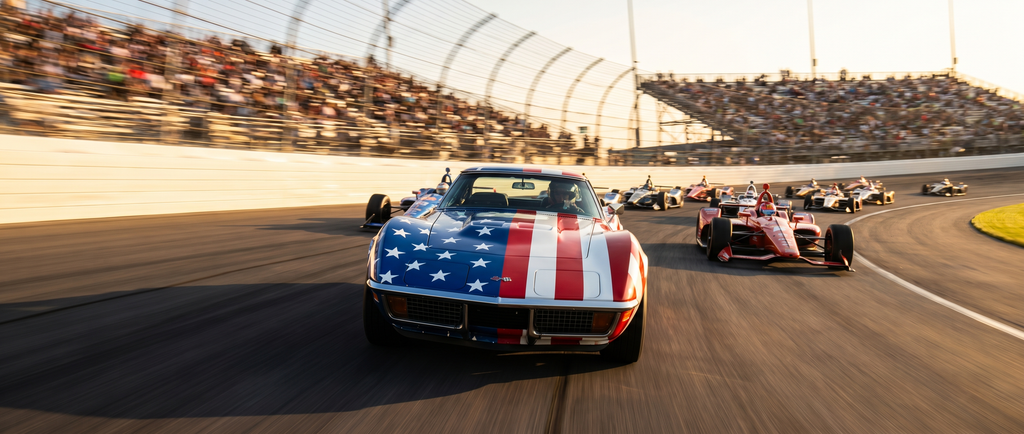
Yesterday at the Indianapolis Motor Speedway, a 1,250 horsepower hybrid Corvette led 33 IndyCars to the green flag for the 110th running of the Indy 500. It was faster than the race cars behind it. It wore a two-tone patriotic livery celebrating America's 250th anniversary. And it is the most powerful Corvette ever built.
The Greatest Spectacle in Racing ran yesterday. For the 10th consecutive year, a Corvette paced the field. But this year was different: for the second year in a row, the pace car was faster than the race cars it was leading. The Corvette ZR1X produces 1,250 hp. The IndyCars behind it produce approximately 650. The most powerful Corvette ever built, at the most famous oval in the world.
110th Indy 500.
May 24.
The ZR1X leads.
The 110th Indianapolis 500 presented by Gainbridge ran yesterday at the Indianapolis Motor Speedway in Speedway, Indiana. Before a single green flag lap was turned, the moment of the day belonged to the pace car: a 2026 Chevrolet Corvette ZR1X in a custom two-tone Stars and Steel livery, combining Arctic White on the driver's side and Admiral Blue on the passenger's side, with patriotic striping running down the centre line. Santorini Blue seats, red seat belts, and red stitched floor mats completed the interior.
The honorary pace car driver was Curt Cignetti, the Indiana University head football coach who led the Hoosiers to their first undefeated season and national championship. For the 10th consecutive year, a Corvette led the field to the green flag. For the 23rd time since 1978, America's sports car performed this duty at the most famous oval in the world. And for the second year running, the pace car was significantly more powerful than the race cars it was pacing.
America's hypercar will be front and center at the Indianapolis 500, and it has the speed to stay there. The ZR1X is made for the race track. This Corvette, inspired by America's 250th anniversary, will absolutely give Coach Cignetti and the fans a thrill., Tony Roma, Corvette Executive Chief Engineer
What the ZR1X
actually
is
The Corvette ZR1X is not a ZR1 with a bigger engine. It is a fundamentally different machine. The base ZR1 uses a twin-turbocharged 5.5-litre flat-plane crank V8, the LT7, producing 1,064 horsepower through the rear wheels. The ZR1X adds a front-mounted electric motor to that equation, creating a hybrid all-wheel drive system that bumps the combined output to 1,250 horsepower and over 1,200 lb-ft of torque. All of this is channelled through a carbon fibre body that generates more than 1,200 pounds of downforce at top speed.
The result is a production car that reaches 60 mph in under two seconds and achieves a top speed of 233 mph. To put those numbers in context: the pole position speed record at Indianapolis was set by Scott McLaughlin in 2024 at a four-lap average of 234 mph. The Corvette ZR1X, the road car, is within one mph of the all-time qualifying record at the world's most famous oval. It is not figuratively an American hypercar. It is literally one.
10 years
of Corvette
at Indy
The relationship between Corvette and the Indianapolis 500 is one of the most consistent in American motorsport. Chevrolet has paced the race 37 times since 1948, and since 1978, a Corvette has led the field on 23 occasions. The current streak of ten consecutive years began in 2017 and has included everything from the C7 Grand Sport to the C8 ZR1. Each year, Chevrolet uses the Indy 500 as a showcase for the most extreme version of its most iconic car.
The 2025 pace car, a standard ZR1, was notable for being the first time in the race's history that the pace car was more powerful than the IndyCars behind it. The ZR1X in 2026 extends that gap considerably: roughly double the power of the 650-horsepower, 2.2-litre twin-turbo V6 IndyCar engines. The symbolism is intentional. Chevrolet's road car technology has, at least in terms of peak power output, overtaken its racing programme. That is an extraordinary claim, and an accurate one.
America's 250th.
Two-tone.
Stars and Steel.
The design of the 2026 Indy 500 pace car is directly tied to the United States' 250th anniversary, celebrated throughout the year as the semi-quincentennial. Chevrolet's Stars and Steel Collection offers 250 specially configured ZR1X models to private buyers in a similar patriotic specification. The pace car's livery takes this a step further with a split two-tone finish that divides the car literally in half: Arctic White on the driver's side, Admiral Blue on the passenger's side, with a stripe running precisely down the centre of the car from nose to tail.
It is one of the most visually distinctive pace car liveries in the race's history. From directly above, the car appears to be two different vehicles merged at the centreline. At speed on the oval, the effect creates a visual impression unlike any previous Indy 500 pace car. The choice to run patriotic colours in the 250th anniversary year is straightforward. The execution, splitting the colours vertically rather than horizontally, is anything but.
As we celebrate America's 250th anniversary, this Pace Car design reflects both where we've been and where we're headed. Every element, from the badging to the colors, were deliberately crafted to honor this milestone while expressing a forward-looking vision of Chevrolet design., Phil Zak, Chevrolet Global Executive Design Director
The Greatest
Spectacle in
Racing
The Indianapolis 500 is the oldest major motorsport event in the world. First run in 1911, it has taken place every year since 1946 without interruption, has attracted the greatest drivers across every era of racing, and remains the highest-attended single-day sporting event on the planet, with crowds regularly exceeding 250,000. It is simultaneously a race, a cultural institution, and an annual statement about the state of American motorsport.
The 110th running of the race continued that tradition yesterday. Thirty-three drivers, representing the full field of IndyCar series competitors, contested 200 laps of the 2.5-mile oval at average speeds approaching 230 mph. For the fans in the grandstands, the pre-race moment most remembered will be the sight of that two-tone Corvette ZR1X, its flat-plane V8 and electric motor combining to generate a sound unlike anything else in the paddock, leading the field slowly around the oval before the pace laps concluded and the race began in earnest.
The Corvette ZR1X did not race yesterday. It paced. But in terms of hardware, it was the fastest thing on track. That is not a marketing claim. It is a fact that required decades of engineering progress to become true. The production car outpacing the racing series it was built to celebrate. There is a poetry in that which no amount of press releases can adequately capture.
When the road
car beats
the race car
The Corvette ZR1X being faster than the IndyCars it paced is not just a quirk of scheduling. It is a data point that tells a story about where automotive technology has arrived in 2026. The electrification of production cars, much debated and much resisted, has produced a generation of road vehicles with performance figures that would have been unimaginable in racing applications fifteen years ago.
The 2026 Corvette ZR1X produces 1,250 hp from a hybrid system combining a naturally aspirated flat-plane V8 with a front electric motor. The IndyCars it led produce approximately 650 hp from a turbocharged V6. The road car has nearly twice the power. And it does so in a package that includes air conditioning, a full interior, a boot, and enough noise insulation to make it liveable on a public road.
For car enthusiasts, this moment is worth pausing on. The performance ceiling of what can be bought, road-registered, and driven to a race track has risen so dramatically in the past decade that the gap between road and race is now, in some measurable respects, reversed. The ZR1X is not the last word in this conversation. It is the beginning of a new chapter. And that chapter started at Indianapolis Motor Speedway yesterday, at 233 mph, in Arctic White and Admiral Blue.
Inspired by
American racing?
Build an icon now.
The Corvette ZR1X dominated Indy yesterday. American motorsport has always produced legendary machines. At tourismobrick.com, our Race Cars collection celebrates the icons that defined their eras: the BMW M3 E46 GTR that conquered American racing, the Porsche GT3 RS, Han's RX-7, and the Audi RS6.
Shop our Race Cars collection →