
Built Not Bought: What the Car on Your Desk Says About You
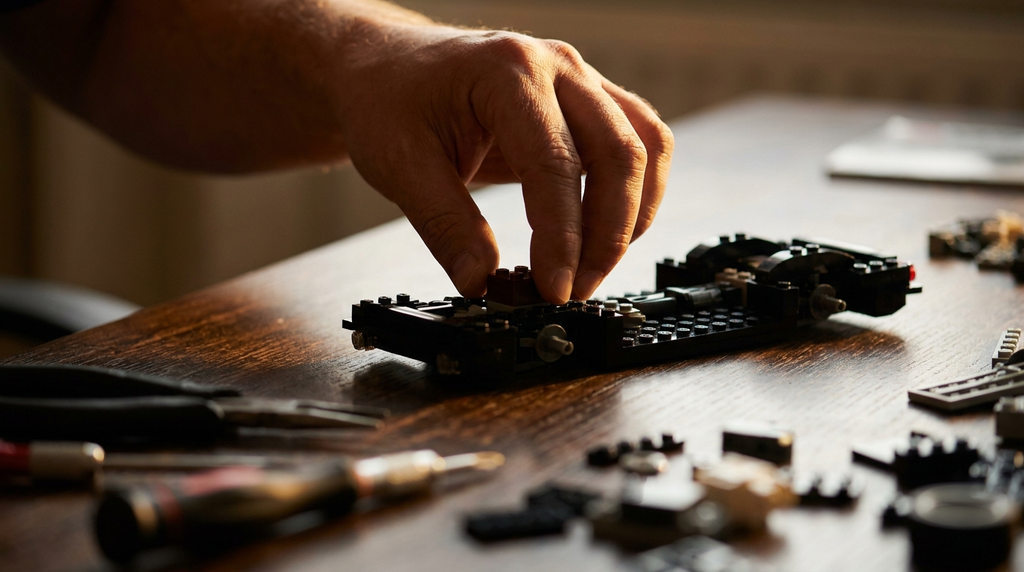
Built Not Bought:
What the Car on
Your Desk Says
About You
Anyone can buy a model. Not everyone builds one. The difference between the two is not the object sitting on the desk. It is the two hours you spent getting it there: the decisions made, the sections completed, the precision demanded of yourself. That difference is visible every morning. And it says something.
There are objects on desks that were purchased. There are objects on desks that were built. They can look identical to a passing glance. They are not the same thing. One was chosen from a catalogue and arrived in a box ready to display. The other was assembled, piece by piece, by the person looking at it now. The first says: I have taste. The second says something more specific than that.
Bought says
taste. Built says
something more.
The objects that surround a person in their workspace are not neutral. Every item on a desk is either there by default, the charger that never moved, the pen holder from a corporate welcome kit, or it is there by choice. The things that are there by choice communicate something about the person who chose them. Not loudly. Not with labels. But consistently, to everyone who sits across from that desk or walks past it in an open-plan office.
A precision car model on a desk communicates interest. It says: this person cares about cars, about design, about engineering or racing history. That is the baseline. A precision car model on a desk that the person on the other side of it built themselves communicates something more specific: this person chose to spend two hours of their own time building something with their hands rather than ordering the finished version. They demanded precision of themselves, not just of the product. They made 350 individual decisions about where each piece belonged. And then they placed the result somewhere visible. That is a different statement entirely.
Two hours.
350 decisions.
One standard.
Building something by hand over two hours is not a neutral act. It is an act of applied attention: sustained, directed focus on a physical task that requires accuracy, patience and the willingness to redo a section when it is not right. People who build Tourismo Brick models describe the experience consistently: the first twenty minutes have a learning curve. The middle hour is the state where time disappears. The final section, fitting the last pieces of a section they have been working toward, produces a specific satisfaction that is different from the satisfaction of completing almost anything else.
The model.
The car.
Both say something.
The fact that you built the model is the first statement. The car you chose to build is the second. These are not equivalent statements, but they reinforce each other. A person who built a BMW M3 E46 GTR communicates an interest in motorsport history, in the specific story of a car so extreme that BMW engineered a secret V8 to make it legal for Le Mans. A person who built the GT3 RS communicates a commitment to the highest expression of road car performance. A person who built Han's RX-7 communicates an attachment to a specific cultural moment that shaped how a generation understood car culture.
None of these are casual choices. The person who walks past your desk and recognises the E46 GTR knows something specific about you. The person who doesn't recognise it still sees a model that was built, not bought: something precise, deliberate and permanent on a desk that contains it by choice. Both readings are correct. Both say something worth saying.
People ask about it constantly. I say I built it. They look at it differently after that. That difference is exactly why it's on my desk., Verified builder, Reddit
Zero stickers.
Pad-printed only.
Your standard matters.
The identity argument only holds if the product is worth the identity. A model built from a kit with sticker decals instead of pad-printed markings produces a finished object that announces its own compromise. The person who built it made 350 careful decisions and then accepted stickers for the details that required precision. The desk object carries both messages simultaneously.
Tourismo Brick uses pad-printing exclusively on every model. No stickers. No decals. The markings on the finished GT3 RS are the same markings as on the real car: applied with pressure, not adhesive, permanent in the same way that precision engineering is permanent. This is not a product detail. It is a statement about what standard the object on your desk should meet. You built something. It should be worth the two hours you gave it. Zero stickers is the baseline for that.
The desk.
The build.
What it communicates.
The people who describe their Tourismo Brick build in terms of identity and personal standard consistently say the same things. The build changed what the object meant to them. The desk object changed how other people related to them in the space. The model is not decoration. It is a statement that happens to be beautiful.
Buy it or
build it.
One of those is you.
The Tourismo Brick models are available. The choice to build one rather than display a purchased alternative is a small choice in terms of cost and a significant one in terms of what the result means. The object is the same size. It occupies the same space on the desk. It is made of the same precision ABS pieces. The difference is entirely in the two hours between the kit arriving and the model taking its place on your desk.
That two hours is not a cost. It is the point. The person who spends two hours building something with their hands to the standard that the car deserves is telling themselves something about what they value. The object on the desk, built not bought, is the physical evidence of that statement. It is not for everyone. The people it is for know exactly what it means when they see it on someone else's desk. And they know exactly what they want on theirs.
Built not bought.
Two hours.
Zero stickers.
The Tourismo Brick collection is there for the people who build. The GT3 RS, the E46 GTR, Han's RX-7, the Audi RS6. $32.90. 350 pieces. Pad-printed without compromise. Built by you. Permanent on your desk.
Build yours →