
Your Desk Is the One Space You Curate for Yourself. What Does It Say?
Your Desk Is the One
Space You Curate
for Yourself.
What Does It Say?
In a shared office, your desk is the one square metre that belongs entirely to you. Every object on it communicates something to every colleague, client or visitor who passes by. Most desks communicate nothing beyond occupancy. The desks that say something specific belong to people who chose their objects deliberately. The question is what yours is saying right now.
A desk is not a neutral surface. It is the only space in a professional environment where personal expression is both expected and visible. The people who understand this choose every object on it with intention. The people who don't end up with a corporate mug, a charger that belongs to a phone they replaced two years ago, and a stress ball from a conference they can't remember. The desk tells the story either way. The question is which story.
One square metre.
Entirely yours.
What are you
doing with it?
The professional workspace has become increasingly standardised. Open-plan floors, hot-desking policies, identical monitors and keyboards across entire buildings. In this environment, the personal desk, where one still exists, has become the primary site of individual expression within the professional context. It is the one surface where a person's choices are visible not as interruptions to the work environment but as permanent, sanctioned features of it.
Most people underuse this space. They fill it by default: the laptop that the company provided, the headphones that were on sale, the coffee mug with the logo of a brand they don't particularly care about. These objects communicate something: indifference to the surface, or an absence of deliberate thought about what it says. Neither is a strong position. The people whose desks communicate something specific chose that outcome. They identified the objects they wanted there and placed them with intent. The desk is not a background. It is a foreground.
The audit.
What each object
communicates.
Every object on a desk communicates something. The communication is not always intended. It is always received. A desk that contains only corporate-issued equipment and an empty coffee cup communicates one set of things. A desk that contains one deliberate personal object communicates something different. The object does not need to be elaborate. It needs to be chosen.
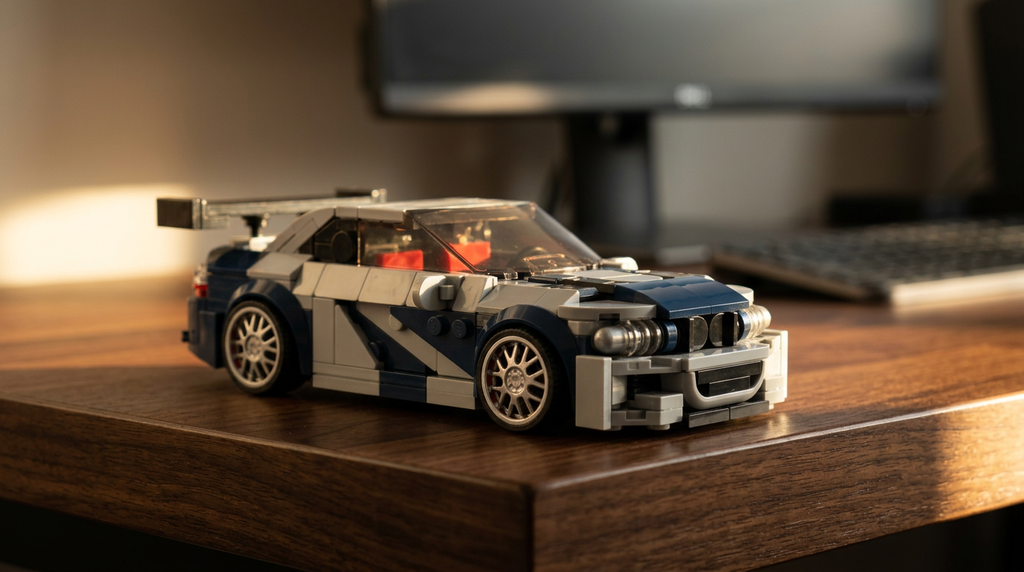
The precision car model is the rare desk object that communicates at two levels simultaneously: it says something to the person who recognises the car, and something different but equally strong to the person who doesn't. Both audiences leave the desk having formed a specific impression of the person sitting at it. That is what a deliberate desk object does. It creates impressions that a default desk object never generates.
Someone
always asks.
That is the point.
A well-chosen desk object starts conversations. Not constantly, not intrusively, but reliably. The person who notices an E46 GTR on a colleague's desk and recognises it immediately knows something specific about the person sitting there. The person who notices it and doesn't recognise it asks what it is. Both responses open a conversation that would not have happened without the object. And the conversation that follows is always more interesting than the one that didn't happen.
Close-range
scrutiny.
Every day.
A desk object is examined at close range, repeatedly, by people who have time to look. This is different from a painting on a wall or a sculpture in a foyer. A desk object is seen from thirty centimetres in good light, multiple times a day, by the person who sits at the desk and by everyone who leans across it for a conversation. Any compromise in the object's quality is visible at that range. A sticker that has lifted at one corner. A paint finish that has chipped. A marking that was applied with adhesive rather than pressure.
This is the reason pad-printing matters at desk scale in a way that it does not matter at shelf scale. The Tourismo Brick GT3 RS on your desk will be examined from thirty centimetres by your most observant colleagues. The pad-printed markings hold at thirty centimetres the same way they hold at three metres. There is no distance at which the quality fails. That is what a desk object requires: quality that survives close examination by people who are paying attention.
A client picked it up, turned it over, looked at every angle. Put it down and said "that's properly made." That was before we'd discussed anything about the project., Verified builder, Reddit
Not just the office.
The desk where
you do real work.
The argument for a deliberate desk object applies with equal force to the home workspace. The home desk is the most personal professional space that exists: it belongs entirely to you, contains objects chosen exclusively by you, and is seen by the people whose opinion of you matters most. The home desk is also the background of every video call, every shared screen, every moment when a colleague or client sees your environment rather than just your face.
What is in the background of your video calls communicates something. A blank wall communicates one thing. A bookshelf communicates another. A precision car model, visible or not on camera, communicates something specific to you every time you sit down at the desk: that this space belongs to someone with a particular set of interests, a particular standard of quality, and a particular relationship to the objects that surround them. The home desk is the desk you see more than any other. What it says to you, every morning, matters as much as what it says to anyone else.
The desk.
The model.
The impression.
One deliberate
object. One desk
that says something.
The Tourismo Brick collection is built for desks that say something specific. The GT3 RS, the E46 GTR, Han's RX-7, the Audi RS6. $32.90. 350 pad-printed pieces. Built by you. On your desk. Every morning.
Choose your car →