
GM Invested $691 Million to Keep the V8 Alive
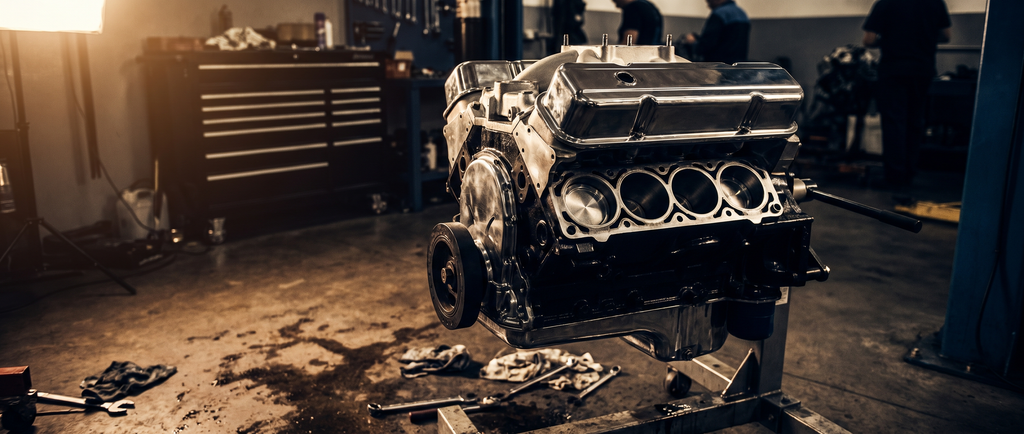
GM Just Invested
$691 Million to Keep
the V8 Alive.
General Motors announced today a $691 million investment in its St. Catharines plant in Ontario to build the sixth generation of its V8 engine. This is the third such announcement in three years. The message could not be clearer: the V8 is not going anywhere.
In a world rushing toward electrification, General Motors has spent billions reaffirming its commitment to the V8 engine. Today's announcement brings total investment in next-generation V8 production to well over two billion dollars across three plants and three years. The internal combustion engine is not dead. It just got a very large cheque.
St. Catharines.
Ontario.
$691 million.
General Motors Canada confirmed this morning a C$691 million investment in its St. Catharines Propulsion Plant in Ontario, Canada. The purpose: to prepare the facility for production of the sixth generation of GM's V8 engine, which will power the company's high-demand full-size trucks and SUVs across Chevrolet, GMC and Cadillac lineups.
Equipment has already begun arriving on site. The plant will continue building the current fifth-generation 5.3-litre and 6.2-litre V8 engines while the new production infrastructure is put in place. St. Catharines becomes the third facility to be confirmed for next-generation V8 production, joining plants in Tonawanda, New York, and Flint, Michigan. The St. Catharines site has now received a total of C$828 million in investment since 2020.
St. Catharines Propulsion continues to play a key role: today and into the future. It will produce GM's next-generation V8 engines, which power our high-demand full-size trucks and SUVs. : General Motors Canada, April 30, 2026
The announcement comes at a turbulent moment for the auto industry, with US tariffs reshaping supply chains and manufacturers under pressure to accelerate electrification. GM is doing both: investing in electric vehicles at scale while simultaneously committing billions to the engine type that has powered American trucks for seven decades. That is not a contradiction. It is a strategy.
Three years.
Three plants.
Billions spent.
Today's announcement is not a one-off. It is the third major V8 investment GM has made in three years, and the pattern tells a very clear story about where the world's largest automaker actually sees the next decade going for combustion powertrains.
The combined investment across the three plants runs well into the billions. This is not the behaviour of a company quietly winding down a product line. This is a company building the industrial capacity to produce V8 engines at massive scale for years to come. GM is betting that demand for V8-powered full-size trucks and SUVs will remain strong regardless of whatever happens in the EV market, and the sales figures suggest it is a very safe bet.
Because
America still
wants one
The reason GM keeps investing in V8 engines is simple: the full-size truck segment is the most profitable in the entire American automotive industry, and full-size truck buyers overwhelmingly want V8 options. The Chevrolet Silverado and GMC Sierra are consistently among the top five best-selling vehicles in the US. The Cadillac Escalade, powered by the 6.2-litre V8, is one of the most profitable vehicles ever produced.
Electric full-size trucks exist, including GM's own Silverado EV. They are selling, but not at the volume of their combustion counterparts. The vast majority of truck buyers are still choosing petrol powertrains, and among those, the V8 remains a highly desirable option that justifies a significant price premium over six-cylinder alternatives. GM is not abandoning electrification. It is simply being honest that the V8 will be required alongside it for a very long time.
The V8 engine is not a relic. It is an active, evolving product that continues to generate billions in revenue for the companies that build it. The sixth generation will be more efficient, more powerful, and more durable than anything that came before it.
What we know
about the
next V8
GM has not yet published full specifications for the sixth-generation V8, but the investment pattern and existing patents provide a clear picture of what to expect. The engine family will continue to offer 5.3-litre and 6.2-litre displacements, maintaining backward compatibility with the enormous installed base of GM trucks and SUVs already on American roads.
The Gen 6 architecture is expected to incorporate more advanced cylinder deactivation technology for improved fuel economy, enhanced internal components for greater durability under increased towing demands, and improved thermal management to meet progressively tighter emissions standards without sacrificing the character that has made the Gen V such a strong seller.
The current Gen V V8 already makes up to 420 horsepower in naturally aspirated form in the Escalade. The sixth generation will need to clear that bar while improving efficiency and meeting regulatory requirements. The engineers at St. Catharines, Tonawanda and Flint have done it five times before. The sixth time will be no different.
The end of
the V8 was
always a myth
For several years, the automotive media ran a narrative that the V8 was on its last legs: that electrification would render it obsolete within a decade, that the internal combustion engine was a dying technology, that the next generation of cars would not need cylinders at all. GM's investment programme is the most definitive rebuttal of that narrative yet.
Porsche kept the naturally aspirated flat-six and made the GT3 S/C. Alfa Romeo reversed its all-electric plans and brought back combustion. BMW is investing in both electric and combustion in parallel. And now GM has committed over two billion dollars to ensure the V8 has a strong future. The pattern is consistent across manufacturers and continents: the internal combustion engine is not disappearing. It is evolving, investing, and refusing to go quietly.
For car enthusiasts, this is genuinely good news. The V8 is one of the great mechanical achievements in automotive history. Its sound, its torque delivery, its mechanical simplicity relative to its output: these are qualities that cannot be replicated by an electric motor, however fast. GM's commitment today is a commitment to keep those qualities available to the people who want them. And a very large number of people still do.
The V8 engine has powered American trucks, muscle cars and performance SUVs for over 70 years. With a sixth generation now confirmed and billions invested across three continents, it looks set to power them for decades more.
The V8s that
wrote
automotive history
To understand why the V8 is worth $2 billion in new investment, it helps to understand what the engine has meant to automotive culture over the past seven decades. The V8 did not just power vehicles. It defined an era, a sound, an attitude and a connection between driver and machine that became the standard against which everything else was measured.
From the small-block Chevrolet V8 of the 1950s that made performance accessible to the masses, to the legendary LS engines of the 1990s that powered a generation of muscle cars and sports vehicles, to the current Gen V that makes the Silverado and Escalade the benchmarks of their respective segments: the V8 has never been just an engine. It has been the defining mechanical voice of American automotive culture. The BMW M3 E46 GTR that conquered the 2001 ALMS season did so with a V8 developed in secret. The Dodge Charger that fills the streets today runs on a descendant of the same engine family that GM is now investing billions to evolve into its sixth generation.
The enthusiast community has always known this. The V8 was never going to disappear quietly. It was just waiting for the rest of the world to catch up with what the people who actually drive these vehicles already understood: some experiences cannot be replaced. They can only be preserved, evolved, and passed on.
A fan of
legendary engines?
Build one.
The V8 lives on in GM's investment plans. It also lives on at tourismobrick.com, in the form of the BMW M3 E46 GTR: the car that hid a secret V8 inside a body that looked like a road car, and used it to dominate an entire season of American motorsport.
Our Race Cars collection includes the M3 E46 GTR alongside the Porsche GT3 RS, Han's RX-7 and the Audi RS6. Every legend. Every icon. Built by you, brick by brick.
Shop our Race Cars collection →