
Han's RX-7: The Most Iconic Car in Fast & Furious History
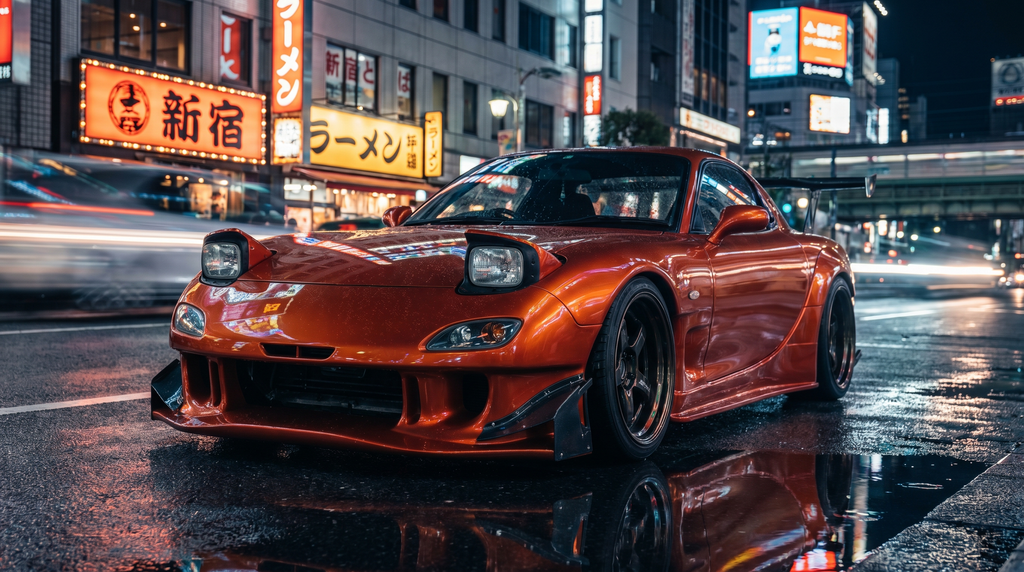
Han's RX-7:
The Most Iconic Car
in Fast & Furious History
Pearlescent orange. Veilside Fortune wide-body. A rotary engine rebuilt by RE-Amemiya. And a character so beloved that Vin Diesel brought him back from the dead. Han's Mazda RX-7 is not just a movie car. It is a cultural monument that just sold for $1.2 million at auction.
When The Fast and the Furious: Tokyo Drift hit cinemas in 2006, most people came for the drifting. They stayed for Han. And the car he drove, a 1992 Mazda RX-7 wearing a Veilside Fortune body kit in pearlescent orange, became one of the most recognisable movie cars ever filmed. Nearly twenty years later, it sold for over a million dollars. Here is the full story.
The RX-7
that changed
everything
The Mazda RX-7 FD was already a legend before Hollywood got hold of it. Produced from 1992 to 2002, the third-generation RX-7 was a rear-wheel-drive sports car powered by a twin-turbocharged rotary engine: a 1.3-litre twin-rotor unit that revved freely, made a distinctive sound unlike any piston engine, and delivered around 255 horsepower from the factory. It was light, balanced, and genuinely brilliant to drive. It was also fragile, thirsty, and expensive to maintain. In other words: a perfect driver's car.
By the mid-2000s, the RX-7 had become a cornerstone of the global JDM tuning scene. VeilSide, founded in 1990 by Hironao Yokomaku, had built its reputation on high-quality aerodynamic body kits that blended aggressive styling with performance. When Yokomaku designed the Fortune body kit for the RX-7, he created something that looked less like a modified car and more like a concept from another dimension: wider, lower, more aggressive than anything road-going Japan had produced before. The Fortune kit won the grand prize at the Tokyo Auto Salon when it launched in 2005. Universal Studios saw it and made a phone call.
Only the roofline and tailgate hint at what the basic donor car used to be before its transformation at Veilside's studios. Everything else was redesigned, widened, and made more extreme.
What Veilside
actually
did to it
To build Han's RX-7 for Tokyo Drift, Veilside started with a 1992 Mazda RX-7 FD and proceeded to transform it almost beyond recognition. The Fortune wide-body kit added over 200mm to the car's width, leaving only the roof and tailgate from the original design. Everything else, the front bumper, rear bumper, doors, fenders, headlights, and side skirts, was replaced with Veilside's own carbon-intensive bodywork.
The front light clusters were custom-built around a carbon shell, housing three separate lamps on each side. The exposed screws were intentionally designed to mimic the armor of Samurai warriors. The 19-inch Andrew Premier Series Racing Evolution 5 wheels were 12 inches wide at the rear, creating an aggressive, deep-dish stance. The car was originally red, but repainted House of Color Sunset Pearl orange for filming.
Under the bonnet, the twin-rotor turbocharged engine was rebuilt by legendary tuner RE-Amemiya and produces around 280 PS. The car weighs just over 1,050 kg. The stunt car used during filming carried a different setup: a single HKS turbo conversion with an HKS intercooler, larger brakes, a titanium exhaust, coilovers, and a nitrous system, said to produce around 500 hp.
Tokyo Drift
and the birth
of Han
The Fast and the Furious: Tokyo Drift arrived in 2006 as a spin-off with almost none of the original franchise characters. It was set in Japan, it focused on drift racing rather than straight-line street racing, and it introduced a cast of new faces. Most of them have been forgotten. One of them became arguably the most beloved character in the entire franchise.
Han Seoul-Oh, played by Sung Kang, was a drifter, fixer, and philosopher who dispensed wisdom between Shinjuku runs. He was cool in a way that did not need to announce itself. And the car he drove matched him perfectly. The RX-7 was used by Han to recruit Sean Boswell into his business after Sean totaled a Nissan Silvia in his first failed race against the Drift King. It also featured in the film's most emotionally charged scene, when Han used it to flee through the Shibuya district and was T-boned by a Mercedes-Benz, causing the RX-7 to flip onto its roof and explode.
Han's death in Tokyo Drift devastated audiences. The character was so popular that the franchise retconned the timeline to bring him back in Fast & Furious 6, 7, 8, and ultimately gave him his own film: F9.
The RX-7 returned with him, at least in spirit. In every subsequent appearance, Han's association with that pearlescent orange Veilside machine remained part of his identity. The car had become inseparable from the character. And the character had become inseparable from the franchise.
$1.2 million
at Goodwood.
A record.
In July 2025, one of the two surviving screen-used RX-7s from Tokyo Drift crossed the auction block at the Goodwood Festival of Speed. The car sold for $1,221,477 USD, a record sale figure for any Mazda road car. The estimate had been between £250,000 and £350,000. It sold for nearly four times the upper estimate.
This particular chassis was not a stunt car. It was the hero model used for close-up and static scenes. When Han meets Sean outside the school for the first time, when Han is in or near the car for any close-up shot, this was the car being filmed. Over 250 vehicles were used during Tokyo filming, more than 80 of which were totaled. The two that survived were shipped back to Japan after filming wrapped, then sold to JDM broker New Era Imports, who brought them to the UK.
The auction result confirmed what the car community had long understood: Han's RX-7 is not just a piece of movie memorabilia. It is a cultural artefact representing the peak of 2000s JDM culture, the golden era of Fast and Furious, and one of cinema's most beloved automotive characters.
Why JDM
changed the
world
To understand why Han's RX-7 matters so much, you have to understand what was happening in global car culture in the early 2000s. Japanese domestic market cars had been a niche enthusiasm in the 1990s: known to tuners, covered in specialist magazines, traded by import specialists. Then Fast and Furious happened, and the niche became a movement.
The original 2001 film put JDM cars on cinema screens around the world. Tokyo Drift went further: it took audiences directly to Japan, showed them the drift scene, the Shibuya district, the underground world of touge racing. For millions of young car enthusiasts who had never been to Japan and never would be, the film was the entire context for their understanding of Japanese car culture. And the car at the centre of it all was Han's orange RX-7.
The rotary engine alone was enough to make the RX-7 mythological. No pistons. No connecting rods. Just a triangular rotor spinning in an eccentric housing, creating combustion in a way that every other car on the road had decided was too complicated to bother with. It was different. It was Japanese. It was perfect for a franchise that celebrated standing out.
Han's RX-7 inspired a generation of car enthusiasts. The Veilside Fortune kit is still being sold today, and replicas are still being built around the world. That is the measure of a truly iconic car.
Nearly 20 years
later, it still
hits different
In 2026, nearly two decades after Tokyo Drift, Han's RX-7 has outlasted every expectation anyone had for it. The franchise has grown into one of the highest-grossing film series in history. Han has appeared in more films than almost any other character. And the orange Veilside Fortune RX-7 remains the single image most associated with the character: more than any racing scene, more than any dialogue, more than any subsequent car he drove.
If you want to build a replica of the Tokyo Drift RX-7, the Veilside Fortune widebody kit is still available at $16,770. A good-condition donor RX-7 will set you back another $40,000 plus. By the time you add wheels, engine work, paint and interior, you are looking at well over $70,000 before the build is finished. And you will still not have the car that Sung Kang actually sat in.
What the RX-7 proved, and what has not changed in twenty years, is that a car can carry a character. The RX-7 was not just Han's transport. It was his personality made physical: stylish without trying too hard, different from everything around it, and impossible to forget once you had seen it. That is not something you can buy at any price. It is something a handful of cars in cinema history have managed to achieve. And Han's RX-7 did it better than almost any of them.
Can't find
the real one?
Build it yourself.
The original sells for $1.2 million. A replica costs $70,000 to build. But at tourismobrick.com, you can build Han's RX-7 brick by brick for a fraction of the price, and display it exactly where it belongs: on your desk, where you can see it every day.
Our Race Cars collection includes Han's RX-7 alongside the Porsche GT3 RS, the BMW M3 E46 GTR and the Audi RS6. Every legend. Built by you.
Build Han's RX-7 now →