
How to Prepare Your Car for the Holidays: The Complete 2026 Guide
How to Prepare
Your Car for
the Holidays
Under-inflated tyres, low engine oil, air conditioning that fails on the motorway in a heatwave: a holiday can turn into a nightmare in minutes. This guide covers everything you need to check, in order, one to two weeks before departure.
A breakdown on the motorway in summer costs an average of £150 to £400 in towing fees alone, not counting the stress, lost time and ruined holiday. In the vast majority of cases, it could have been avoided with a simple 30-minute check before departure. Here is how to do it.
The most
important
check
Your tyres are the only contact point between your car and the road. On a long summer journey, they face the heat of the tarmac, the weight of luggage and passengers, and hours of sustained motorway driving. An under-inflated tyre heats abnormally and can blow out. A worn tyre will not drain water correctly when a summer storm hits. Both situations can be fatal.
Start with pressure. Check it cold, before driving, according to the values on the label inside your driver's door frame. For a long journey with a loaded car, increase the pressure slightly above standard values. The correct pressure is generally between 1.8 and 3 bar depending on your model. Do not forget the spare wheel or puncture repair kit.
Tyre pressure is the single most important check. Incorrect pressure causes overheating and blowout risk. Check all four tyres cold, before you have driven, every time.
Under the
bonnet before
you go
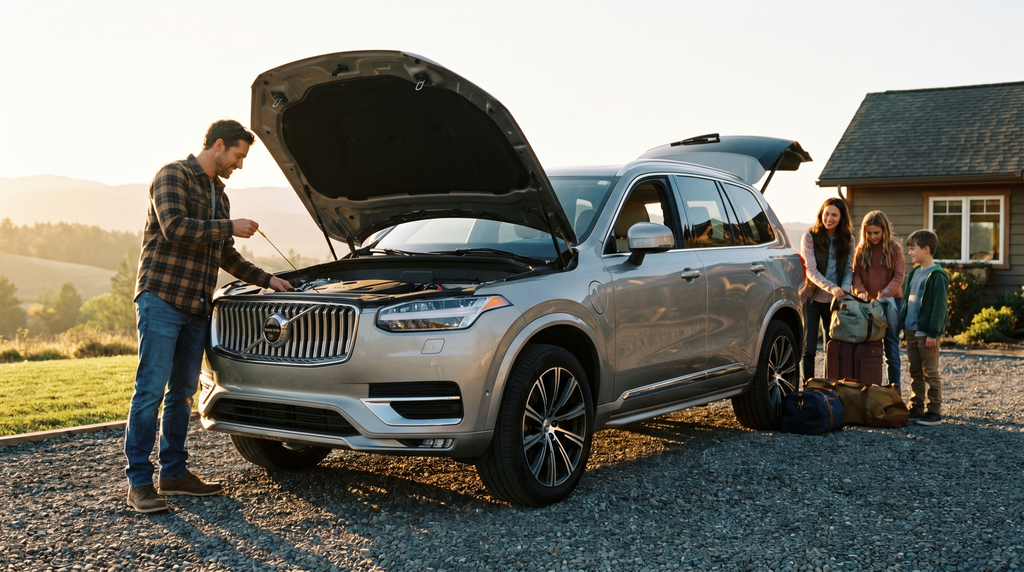
Opening the bonnet is the check most drivers put off indefinitely. It is also the one that can save you from the most expensive problems. In the middle of summer, an engine running low on oil or coolant can fail within minutes in a motorway traffic jam. Replacing a seized engine costs thousands. Checking fluid levels takes five minutes.
Warning : if the brake fluid level is abnormally low for no apparent reason, do not depart before consulting a mechanic. This is not a level to top up yourself without a diagnosis.
Stop safely.
See
clearly.
Brakes are the most critical safety system in your car. On a long journey with a loaded vehicle, they are used more intensively than in normal use, particularly on mountain descents or in repeated slowdowns on busy motorways. If you hear squealing, feel vibration or notice the brake pedal sinking more than usual, get it checked before you depart.
Visibility is equally important. A summer storm can appear without warning. Wiper blades that streak or judder are ineffective in heavy rain. A windscreen with an unrepaired chip can crack under pressure and temperature changes on the motorway. Both are simple and quick to fix before departure.
Summer heat
attacks
everything
The battery is a point most people overlook in summer, wrongly. In high heat, an ageing battery can weaken considerably. If your battery is more than three or four years old and you have not had any warning signs, a check at a garage or with a consumer battery tester can save you from a breakdown on a service station forecourt at 35 degrees.
Air conditioning is your best ally on a summer road trip. A failing air con system means an exhausting journey for everyone on board, and a genuine risk of drowsiness at the wheel. Test it before departure : on a warm day, the air should be properly cold within two minutes. If it is no longer producing intense cold, the refrigerant may need recharging.
For air conditioning : the temperature difference between inside and outside the car should not exceed 5 to 7 degrees. A bigger gap creates a thermal shock risk every time you get in and out of the car.
What the law
requires,
and the rest
In the UK, a warning triangle and a high-visibility jacket are strongly recommended and required in many European countries. If you are driving abroad this summer, check the specific requirements for every country you are entering. France, Spain, Germany and Austria all have mandatory equipment rules that differ from the UK. A fine at a border checkpoint is not the start to a holiday anyone wants.
Beyond the legal minimum, a few simple additions can turn an incident into a minor inconvenience : a puncture repair foam can get you to the next garage without needing a full tyre change, a basic first aid kit covers the immediate needs, and a jump-start cable or portable booster means a flat battery does not strand you. And enough water for all passengers, especially if you are travelling with children or elderly relatives on a hot day.
Once you
have set
off
Preparation does not end when you pull out of the driveway. On the road, a few simple habits make the difference between an enjoyable journey and an exhausting one. The golden rule : take a break of at least 15 to 20 minutes every two hours, and at the first sign of tiredness. Drowsiness at the wheel is responsible for a third of fatal motorway accidents.
For electric and plug-in hybrid vehicles, plan your charging stops before you leave. Locate compatible chargers on your route using apps like Zap-Map or Chargemap, and never let the level drop below 20% in poorly equipped areas. In mountainous regions or in peak summer, queuing times at chargers can be significant. Apps like ABRP can plan the most efficient charging route automatically.
Leave early in the morning to avoid the worst heat, the worst traffic, and to drive when your body is freshest. Drowsiness peaks in early afternoon, particularly after a meal. Early starts are one of the easiest free upgrades to any road trip.
Programme your GPS before starting the engine and download an offline map if your route crosses areas with limited signal. Identify service stations on your route so you are never caught out by an empty tank in motorway congestion. And turn the air conditioning down to a moderate level : the difference between inside and outside temperature should stay between 5 and 7 degrees to avoid thermal shock every time someone gets in or out of the car.
While waiting
for the holidays,
build your dream car.
Your car is ready for the road. And while you wait for the big departure, why not build your next dream car, brick by brick? At tourismobrick.com, our Race Cars collection is waiting : Porsche GT3 RS, BMW M3 E46 GTR, Han's RX-7 and more.
Discover our brick car kits →